

On it's face, the recent In-Demand Skills 2026 report from Upwork makes a reassuring claim for creatives working in video: demand is not shrinking.
In fact, video editing remains one of the strongest and fastest-growing categories on the platform.
That feels like good news, and it’s largely true. It’s certainly been our recent experience as a Top-Rated Plus contractor on the platform. Companies are producing more video than ever. Podcasts, social clips, internal comms, event content, explainers. The volume is real, and it’s growing.
But demand alone doesn’t tell the whole story.
What the report doesn’t fully address is how that demand is being priced, or what kind of work is actually expanding underneath the headline numbers. And that distinction matters, especially for teams trying to build durable creative partnerships rather than chase one-off output.
Demand Is Growing. Pricing Power Is Fragmenting.
The market for video editing has quietly split into tiers.
At the bottom, there’s massive growth in transactional editing: short-form clips, rapid turnarounds, minimal context, minimal ownership. This work is increasingly shaped by global labor arbitrage and AI-assisted tooling. It ships fast. It’s inexpensive…
…and it resets to zero every time a new editor touches the project.
In the middle, there’s real pressure. Skilled editors are competing in a crowded field where speed is often mistaken for value, and where AI’s ability to compress timelines has led many buyers to expect lower costs, even when outcomes don’t improve.
At the top, something else is happening.
Teams that produce video continuously—not occasionally—are realizing that the real cost isn’t editing. It’s fragmentation. Re-onboarding. Inconsistent tone. Lost context. Content that technically ships, but doesn’t compound.
This is where pricing power hasn’t disappeared. It’s simply moved.
Why One-Off Editing Fails at Scale
Recently the trickle of companies who come to us after cycling through junior editors or one-off freelancers has begun to flow and even flood. The story is almost always the same: decent individual videos, but no consistency. No momentum. No sense that the work is building toward anything. And certainly no measurable outcomes.
Every new hire requires re-explaining brand voice, audience, expectations. Feedback grows heavier. Output becomes reactive instead of intentional.
The hidden cost isn’t money. It’s attention.
And for us this is where the conversation has evolved beyond “editing” as a service.
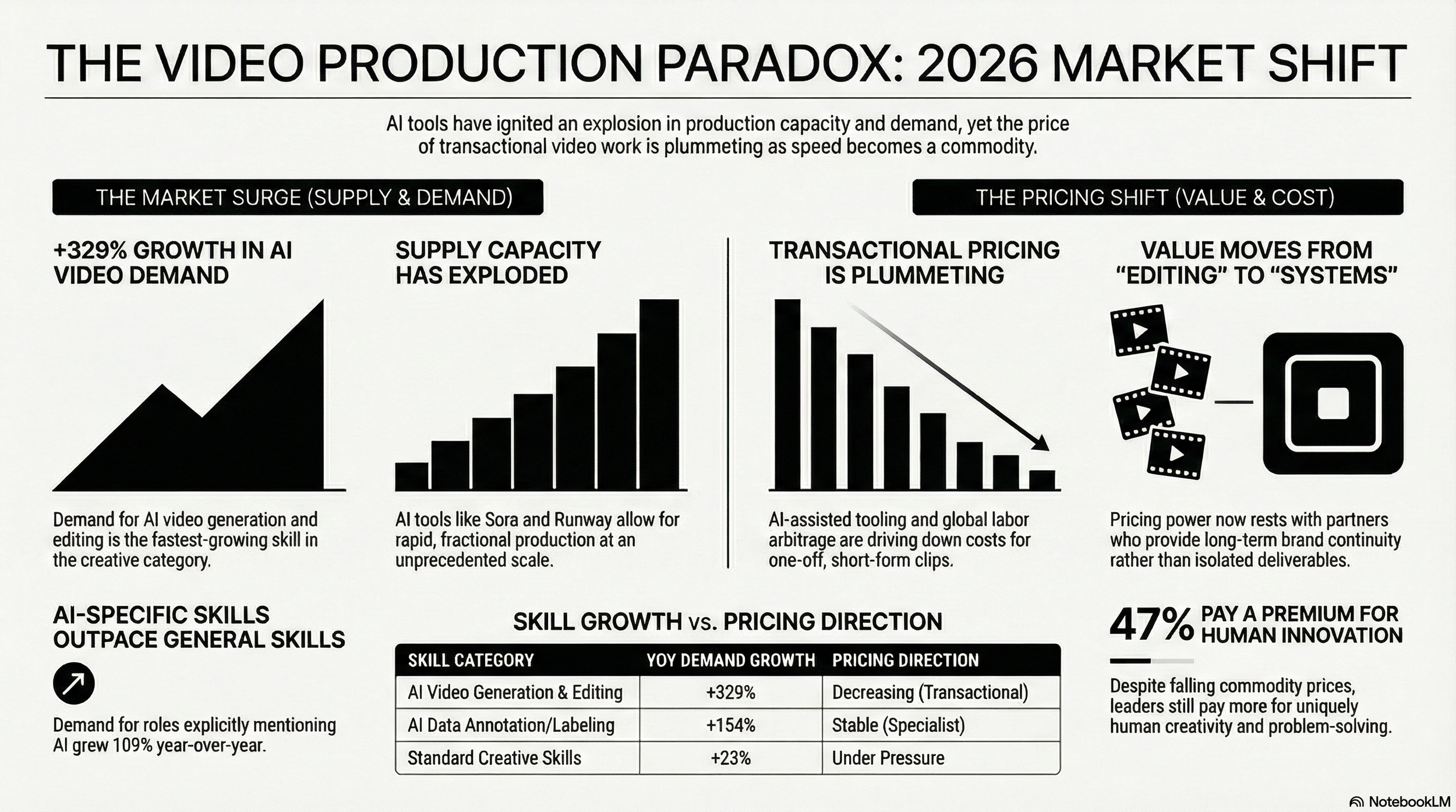
Demand increases plus supply capability explosion drives downward price pressure.
Own the Video Layer, Don’t Rent It
We don’t sell video editing as a standalone commodity. We partner with teams to own the video layer of their brand over time.
Practically, that means we’re best suited for engagements like:
Evergreen podcast clipping systems (episodes turned into intentional Shorts, Reels, LinkedIn, and YouTube content)
Multi-month social video programs with defined output targets
Ongoing founder or executive thought-leadership series
Product or platform update videos released on a recurring cadence
Event content pipelines that extend value well past the event itself
These aren’t one-off deliverables. They’re systems.
Our role blends creative direction, post-production, and editorial continuity so that each asset builds on the last. The goal isn’t just to publish, it’s to compound clarity and consistency over time.
On AI: Powerful, Necessary…and Incomplete
We’re fully favorable toward generative AI and actively integrated with industry-leading tools like Veo 3, Sora, Runway, Midjourney, and modern AI-assisted post-production workflows. Used correctly, these tools dramatically expand speed and creative range.
But AI alone tends to fall flat.
Where real leverage emerges is through a human-in-the-loop (HITL) approach: pairing powerful tools with experienced creative direction, editorial judgment, and strategic intent. AI accelerates execution; humans ensure coherence, taste, and alignment with real business goals.
This combination allows teams to scale content predictably and tie creative work to measurable outcomes, not novelty alone.
What the Market Is Actually Asking For
The Upwork report is right about one thing: AI isn’t replacing creative work. It’s recomposing it.
What we’re seeing is not the death of video editing, but the decline of isolated editing; work that lacks context, continuity, and ownership. In its place is growing demand for partners who can hold the long view: maintain standards, remember decisions, and reduce friction across months, not just milestones.
That’s the lane BRAEID operates in.
If you’re looking for the lowest-cost way to edit a single video, there are plenty of good options. If you’re building a body of work and want someone accountable for how it all fits together, that’s where long-term partnerships begin.
And that’s where we’ve chosen to stand.